
All
Juggling Between Reading Habits and Outdoor Time: An Optometrist’s Perspective on Childhood Myopia in Singapore
By Lee Kang Lian, Optometrist at OJO Optometrist, Parkway Parade, Singapore
Just before we called it a day at the practice this evening, I caught up with a long-time patient who, over the years, has become more like a friend.
Mdm P suddenly brought up a piece of myopia prevention advice I had shared with her a few years ago.
“Children are recommended to spend at least two hours outdoors every day to reduce their risk of developing myopia.”
She was puzzled. “But how do we realistically achieve that in Singapore?”
A very fair question, indeed.
Between school, homework, tuition classes and enrichment activities, finding two hours of outdoor time every day can be quite a challenge for many Singaporean families. And what if your child genuinely loves reading?
Surely, as optometrists, we are not going to discourage children from picking up a book?
That conversation led me to share some practical advice that I often give to parents of children who are at risk of developing myopia, newly diagnosed with myopia, or experiencing rapid myopia progression.
Five simple habits for healthier eyesight in children
1. Make outdoor time part of everyday life.
Research has shown that spending time outdoors in natural daylight can help reduce the risk of children developing myopia.
One proposed mechanism involves the release of dopamine in the retina in response to bright outdoor light, which may help regulate excessive eyeball elongation.
While two hours a day remains the recommended target, every opportunity to spend time outdoors is worth taking. A family outing to the park over the weekend, playing at the neighbourhood playground or cycling along East Coast Park are all wonderful ways to get started.
There is no need to be directly under the scorching sun. Shaded outdoor areas can also provide beneficial daylight exposure.
2. A 20-minute evening walk is a good start.
Instead of heading straight home after dinner, why not take a short family walk while there is still daylight?
It may not fulfil the recommended two hours of outdoor time, but it is a practical habit that families can gradually build upon.
Besides, it is a lovely opportunity to put our phones away, catch up with our children and enjoy each other’s company.
3. Practise the 20-20-20 rule.
For every 20 minutes of reading, studying or screen use, look at something approximately 20 feet (6 metres) away for at least 20 seconds.
This simple habit helps relieve visual fatigue and interrupts prolonged periods of near work.
One practical tip I often share with parents is to get a little cube timer. Set it for 20 minutes and let it remind your child to take a short visual break.
Sometimes, a little gadget is more effective than a parent constantly reminding their child!
4. Maintain a healthy reading distance.
Whether your child is reading a novel, completing homework or using a tablet, encourage a comfortable working distance of approximately 30–40 cm, with adequate lighting and good posture.
It is not just screen time that we should be mindful of. Prolonged reading and other activities performed at very close distances deserve our attention too.
5. Encourage your child to discover a new outdoor hobby or sport.
This is perhaps one of my favourite recommendations because of what I have observed in my own practice.
I once looked after a young girl whose myopia had been progressing quite rapidly. Things began to change after she took up outdoor basketball training.
During subsequent eye examinations, we observed that her myopia progression had slowed considerably.
Of course, we cannot attribute the improvement solely to basketball. However, her new routine allowed her to spend more time outdoors and less time engaged in continuous near work.
Her parents and I wished we had discovered this enjoyable activity for her much earlier.
Sometimes, encouraging a child to discover a new passion can be more effective in building lasting healthy habits than repeatedly telling them what not to do.

Why should we be concerned about childhood myopia?
Myopia, commonly known as short-sightedness, is not simply about wearing thicker spectacles, paying more for prescription lenses or having blurrier distance vision.
As myopia increases, the eyeball often becomes excessively elongated. This is associated with a higher lifetime risk of eye conditions such as retinal detachment, glaucoma and myopic macular degeneration.
As an optometrist, my concern is not only how clearly a child can see today, but also how healthy their eyes will be when they are 40, 50 or 60 years old.
Outdoor activities are particularly important in reducing the risk of myopia onset. For children who have already developed myopia, however, healthy visual habits should complement appropriate, evidence-based myopia management rather than replace it.
Regular eye examinations, including axial length measurements where appropriate, can help us better understand how a child’s eyes are developing.
Singapore’s screen time guidelines and the joy of reading
Over the years, Singapore has introduced various national health initiatives, from the War on Diabetes to encouraging healthier eating habits and reducing sodium consumption.
As an eye care professional, I was particularly pleased when the Ministry of Health updated its Guidance on Screen Use in Children on 21 January 2025, as part of the Grow Well SG initiative.
The recommendations include:
- Children below 18 months: avoid screen exposure, apart from interactive video calls.
- Children aged 18 months to 6 years: less than one hour of screen time daily outside school.
- Children aged 7 to 12 years: less than two hours of screen time daily outside school, excluding school-related work.
Parents can read the full Ministry of Health’s Guidance on Screen Use in Children here.
Interestingly, in September 2026, the National Library Board also launched ReadSG, a national movement encouraging Singaporeans to rediscover the joy of reading and cultivate a lifelong reading habit, starting with just 15 minutes a day.
You can find out more about the ReadSG national reading movement here.
I find both initiatives very encouraging.
In a world increasingly dominated by short videos, digital distractions and instant gratification, the ability to sit down with a good book, immerse ourselves in a story and exercise our imagination is something worth preserving.
But can we encourage children to read more while protecting their eyesight?
Absolutely.
It is not about choosing between books and outdoor activities. It is about finding a healthy balance between the two.
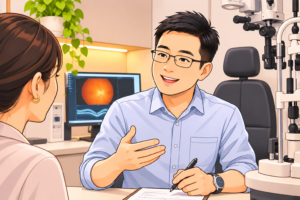
A little reflection from an optometrist
After my conversation with Mdm P this evening, it occurred to me that, as optometrists, we become a small part of other people’s lives.
We watch children grow up, share the concerns of their parents and celebrate the little improvements we see along the way.
Many meaningful conversations take place within our consultation rooms. Perhaps more of these conversations deserve to be documented and shared beyond the walls of our practice.
And voilà! If a Google search, an AI recommendation or some mysterious algorithm has brought you to this article, I hope you have found something useful to share with your family.
I sincerely hope that our future generations will continue to appreciate the beauty of reading, the joy of outdoor play and the wonders of the world beyond their screens.
Let us make healthy eyesight part of that journey, too.


